Rose Circle Books · The Catalog
Published books
Translations, studies, and new writing on Martinism and the Élus Coëns, Rosicrucianism, Hermeticism, alchemy, Kabbalah, and Freemasonry, from the press of the Rose Circle.
- 33 titles
- 2017 first title
- 4 collections
Newest release
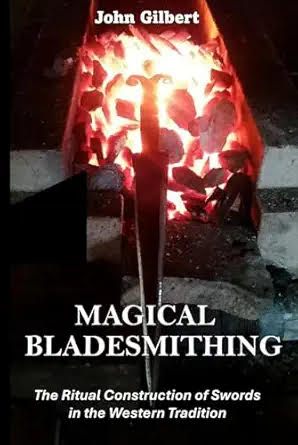
Magical Bladesmithing
The Ritual Construction of Swords in the Western Tradition
From the forge emerges a blade that is not just a weapon, not even a magical object, but a living being. What is missing from the narrative is exactly what the ‘magic swordsmith’ does, ritualistically and ceremonially, to actually produce such an entity. That gap in knowledge is the subject of this book: How does the swordsmith create a magic sword in the Western tradition?
From the forge emerges a blade that is not just a weapon, not even a magical object, but a living being. What is missing from the narrative is exactly what the ‘magic swordsmith’ does, ritualistically and ceremonially, to actually produce such an entity. That gap in knowledge is the subject of this book: How does the swordsmith create a magic sword in the Western tradition?
‘The West’ and ‘Western tradition’ are highlighted here, not to make a comparison with Eastern practices in this area, but only to point out that it is especially in European sources that details of the smith’s ‘magical’ methods are scarce, to say the least. Using related European historical sources for context, and the more detailed records of some other traditions as a template, an ‘informed reconstruction’ – an educated guess – can be made.
What is offered here, to both the current and the aspiring bladesmith, as well as to the curious reader, is a starting point and a generalization of what the ritual construction of a sword in the Western tradition might look like.
At the heart of the three texts gathered in this book resides an essential subject—we might even say the sole subject—discovered within every tradition, and particularly within Judeo-Christian traditions: the path of the Body of Light, the Body of Glory, the Body of Immortality, the Christic Body—depending on the expressions used, all of which indicate a process of internal alchemy, inscribed, among other things, in the myth of the reconstruction of Solomon’s Temple, often closely associated with a theurgy, whether explicit or implicit.
If myths work to modify our model of the world in order to make us receptive to “that which endures,” it is the mythic structures composing them that carry the operative powers of the inner ways, a veritable language to be deciphered in an initiatory process closer to art than to science.
This book reimagines Rosicrucianism not as a secretive order or mystical abstraction, but as a living philosophy centred on death, grief, and spiritual reintegration. Blending esoteric Christianity, Hermetic symbolism, and modern science – from near-death experiences and quantum physics to parapsychology – the author explores the mystery of mortality through the lens of the Rosy Cross.
Anchored by sudden personal loss, the narrative moves from myth to medicine, from Shakespeare’s tomb to the vault of Christian Rosenkreutz, asking: what truly happens when we die? And how do we prepare for it?
Far from a dry academic treatise, this is a daring synthesis of mysticism and experience, offering readers a practical guide to the final initiation—and the possibility of a “good death.” Whether you’re a seeker, sceptic, or student of the occult, this book invites you to pass through the veil and discover what lies beyond.
This book reproduces a full medieval Office of the Holy Spirit as well as the rare Hours dating from the eighteenth century. For each manuscript there is a transcription of the Latin text and a rendering into English drawn from existing devotional texts.
The introduction discusses the theology underlying the use of the Office of the Holy Spirit by the eighteenth-century mystic and theurgist Martinez de Pasqually, with a particular focus on his choice of the penitential psalms Miserere Mei and De Profundis when reciting the Office.
Reverence of the Holy Spirit was important to Pasqually, who understood that the liturgy of the Church contained spiritual power. It was therefore fitting for him to encourage his own secret priesthood to recite these ancient prayers to the Advocate and Illuminator of man.
The phrase “as above, so below” has become a central axiom of much Western mystical and occult philosophy. It seems to convey, in four words, the so-called “Law of Correspondence” whereby the macrocosm exists in a state of mutual influence and interaction with the microcosm.
This reexamination of the oldest known source texts seeks to challenge these claims—it even challenges the very title “Emerald Tablet” given to the brief Hermetic text venerated by students of Western esotericism. While not arguing for or against Correspondence in principle, Not as Above, Not as Below is a call to set the record straight on where these ideas came from, and what the “Emerald Tablet” may actually be talking about.
Other books by John Gilbert include Temple of the Masonic Order, The Song of God, and Pseudo-Hermetica for the 21st Century.
This collection of nondualist texts by Rémi Boyer forms an anthology that is both classic and singular, traditional and avant-garde, in response to a suggestion made to the author in 1998 by Lima de Freitas: “The avant-gardes widen the breach in opacity so that the traditions can slip in.”
The philosophical, metaphysical, alchemical, and poetic texts gathered here were published in France, Spain, and Portugal over the last three decades. They relate to the philosophies of awakening, the traditions of internal alchemy, and nondual metaphysics, but above all convey a method and a discipline of the arcane implemented on a daily basis.
Whether with vigor or elegance, the words disorganize and disturb the conditioned to leave free space for Being and to open the doors of luminous infinities leading to the Recognition and Reintegration of our Original Nature. In reality, it is only a matter, sound after sound, word after word, of Freedom.
A new and unabridged translation of the surviving papers of Lieutenant-Colonel Pierre André de Grainville (1728–1794), an initiate of the enigmatic Martinez de Pasqually, founder of the mysterious Élus Coëns.
Having progressed through the Order’s ranks, de Grainville kept notes of his theurgical operations. Known as ‘les manuscrits de Grainville’ or ‘le manuscrit d’Alger’ and held at the Bibliothèque nationale de France, the folios are not a complete Coën grimoire, but a fragmentary snapshot of the original rituals in a state of rapid development.
Includes both BnF folios FM4 1282 and FM4 1282A.
To better understand William Blake, it is necessary to understand his sources of inspiration. While much has been written about the influences of Paracelsus and Swedenborg, a key influence on Blake was the self-taught sixteenth-century mystic Jacob Boehme. Both men believed they had mystical experiences and visions that inspired their writing.
The author meticulously dissects Blake’s tempera painting ‘An Allegory of the Spiritual Condition of Man’, examining the painting as a whole and its constituent parts before reassembling it.
Rich in Kabbalistic and alchemical interpretation, the book leads readers on a journey that deepens their understanding of the philosophical alchemy underpinning Blake’s mysticism.
The Treatise on the Reintegration of Beings of Martinez de Pasqually (c. 1727–1774) was partially finished at his death. It was intended to be a full commentary on the Pentateuch, and what we have was composed during the period when Pierre Fournié and Louis-Claude de Saint-Martin were his personal secretaries.
Like his contemporary Emmanuel Swedenborg, Pasqually is said to have experienced dreams and visions of spiritual realms and the multiplicity of beings inhabiting them. The Treatise includes elements of spiritualism and strong alchemical and Rosicrucian principles.
Narrated by Ike Baker · Preface by Matt Fletcher · Audio engineering by Adam Audioworks.
The Treatise on the Reintegration of Beings into Their Original Estate, Virtues and Powers both Spiritual and Divine, of Martinez (Martinés) de Pasqually (c. 1727–1774), was partially finished at the time of his death. It was intended to be a full commentary on the Pentateuch, composed while Pierre Fournié and Louis-Claude de Saint-Martin were his personal secretaries.
Like his contemporary Emmanuel Swedenborg, Pasqually is said to have experienced dreams and visions of spiritual realms and the multiplicity of beings inhabiting them. The themes of the Treatise include elements of spiritualism and strong alchemical and Rosicrucian principles.
A lucky discovery in the archives of the Sorbonne led Stewart Clelland (co-author of The Green Book and The Master’s Voice) to bring to the public unpublished poems by a man who had a major influence on the esoteric revival of the 19th century: Éliphas Lévi, or Alphonse Louis Constant.
Written towards the end of his life, these poems reflect his extraordinary sojourn on earth as a clergyman, a revolutionary, and the author of some twenty important books on esotericism. If poetry is a window to the soul, these poems are a major contribution to understanding how his mind worked.
With a significant explanatory introduction by Mathieu G. Ravignat.
This book could just as well have been titled The Rectified Scottish Rite as a Way of Awakening, completing the triptych of works by Rémi Boyer on the ways of awakening through the Rose-Croix, Freemasonry, and Martinism.
Boyer presents and comments on the Grades of the Order, as well as the Instructions to the Professed and especially those of the Grand Professed, which give a remarkable synthesis of the Doctrine of Reintegration.
Founded in 1754 by the enigmatic Martinez de Pasqually, the Order of Knight-Masons Elect Priests of the Universe (or Élus Coëns) left an indelible impression on French Freemasonry and worldwide Martinism.
Pasqually’s Élus Coëns worked tirelessly for the restoration of man’s inner divinity and eventual reintegration with God. The fraternity practiced a system of white magic (theurgy) aimed at recovering humanity’s original, spiritual memory.
Pierre Fournié (1738–1825) wrote this treatise between 1774 and 1801. It is translated here into English in its entirety for the very first time.
The Abbé’s work focuses on the core Martinist doctrine of reconciliation, regeneration, and reintegration expounded by the original Élus Coëns of Martinez de Pasqually—an incomparable record of one of the leading lights of eighteenth-century French esotericism.
With a detailed introduction on the Abbé’s life and influences, and a Preface by the Great Sovereign of the Ordre des Chevaliers Maçons Élus Coëns de l’Univers, O.O.E.C.
The forty-four Letters to Friends of the Spirit were sent in five languages as weekly “Briefs” during the periods of restricted freedoms in 2021, to members of initiatory, Masonic, Martinist, Gnostic, Pythagorean, Rose-Croix, Swedenborgian, and other organizations in order to support practice.
Topics include prayer and meditation, the meaning of prophecies, the use of Hebrew, the myths of chivalric traditions, the temple and the crypt, the theurgy of the Élus Coëns, the secret grammar, geometry, alchemy, the Arcana Arcanorum, the work of Swedenborg, and the contribution of literature to initiation.
A retelling of the legendary conflict between ancient magic and the Apostolic Church. M.R. Osborne considers the relationship between miracles and magic as they played out in the dramatic confrontation between the Apostles and Simon Magus.
The author investigates how ancient magical operations—necromancy, transmutation, sex magic and transvection, amongst others—acted as opposing forces to the sacramental powers of the Primitive Church.
M.R. Osborne explores the famous image of the Nehushtan, or Brazen Serpent, set up by Moses to cure the Israelites, seeking the Divine Code hidden within the laws of Nature.
An examination of the influence of the occult on the works of William Shakespeare, with a particular focus on his funerary monument in Holy Trinity Church, Stratford-upon-Avon.
The author considers the ciphers and geometrical codes hidden within the memorial, and approaches what appears to be a traditional stone of its time from Masonic, Rosicrucian, and Kabbalistic viewpoints.
A manifesto by Papus providing a history of the founders of modern Martinism, its relationship to French Freemasonry in the late 1800s, and an explication of the landmarks of Martinism.
The first book in the ‘Way of Awakening’ series by Rémi Boyer, a renowned contemporary esoteric writer, exploring the use of Masonry to achieve the Path.
The second book in the ‘Way of Awakening’ series by Rémi Boyer, exploring the Path from the viewpoint of Martinism.
The third book in the ‘Way of Awakening’ series by Rémi Boyer, completing the trilogy with a look at the Rosicrucian Path of enlightenment.
A full-color reissue of the famous book allegedly by St. Germain or Cagliostro, containing high-quality copies of all the original alchemical plates and a translation by M.R. Osborne.
Lenain’s seminal book on the Shemhamphorasch, published in 1823 and reissued by Papus in 1909. Contains a new interpretation of the seals based on Lévi’s descriptions.
Saint-Martin’s second book, published in 1782, continues his exploration of the relationships of God, Man and the Universe through a look at history and theosophy.
Originally published in 1893, this important book summarizes the main grimoires and explores contemporary mysticism in the fin-de-siècle France of the late 19th century.
Saint-Martin’s first book, published in 1775, launched an attack against the atheists and Encyclopedists of the time, using Masonic symbolism to reveal the existence of God.
Bringing together Saint-Martin’s and Papus’ posthumously published works on Numbers, this book provides a philosophical, mystical, and theosophical analysis of the building blocks of creation.
The second book in the “Renaissance Man and Mason” series. Drawing most of its ideas from 18th-century Masonry, it continues the threads begun in the first book in eight longer talks.
A book of talks given by the author over twenty years. Focused on Freemasonry, it contains papers on history, symbolism, esotericism and speculation on Regular Masonry, York Rite and Scottish Rite Masonry.
Written by a Grand High Priest to meet the Royal Arch education needs of his State, this book is now used in over 20 States, recommended by the General Grand Chapter, and adapted for 4 States.
A compendium of ancillary rituals, short talks, festive board rituals, rituals for the Ladies, and other gems, collected in a ring-bound book for easy photocopying, with no copyright restrictions.
The republishing of a Templar ritual from the 1880s discovered in a commandery in Tennessee. This lavish volume reproduces the original handwritten rituals and illustrations together with contemporary commentaries and updated transcriptions.
Currently available from the Knights Templar Eye Foundation for a (deductible) $150 donation to their charity.
No titles match that search.